Creative sparks, extracurricular interests, internet finds, life updates, and anything else that might be milling in my head. Subscribe to my Posts or by e-mail for updates. If you'd like to read about my study abroad experience in Rome, Italy, try the La Vita Bella tag!
Facebook is notorious for making changes to their (recently IPO'ed) platform, without much user input. I understand that users don't necessarily have the future of the platform in mind, but I don't understand how facebook could neglect the needs of its advertisers so blatantly.
Their main competitor, Google AdWords, has built in some support offerings (e.g. Google Engage, which my ad agency is a part of) and extensive documentation around their platform. Although much younger, if Facebook plans to get more $ out of its advertiser platform, I would think it should offer some type of support or, at the very least, a quality service.
Here's the story. I went to create an ad today for an event that Rachman and I are hosting this Saturday. I'm not new to Facebook ads by any means - in fact we have been running ads for this very event for the past several weeks, but wanted to test some new targeting and images.
Challenge #1: Can't create an ad for an event in the Firefox browser.
Fine.
Until recently, something was broken in all browsers except - gasp - Internet Explorer!? that prevented ads for events from even being created. Event ads are unique in that they allow a user to click to RSVP right within the ad. Facebook gets some points for having a direct event advertisement platform that ties in nicely with the millions of users that manage their social calendars with Facebook. However, as an advertiser, if I can't create my ad - how are you going to get my money from advertising? Silly silly.
Second point: generally speaking, Facebook support for all major browsers seems to be inconsistent. Any [good] web designer knows to test in all the major browsers. I have three of them installed on my Mac, and more virtually. This allows me to test client projects on many browsers before "launch." It also allowed me to create my event ad today... go figure.
Challenge #2: Facebook ad provides a mere 110 x 80 pixels of space for an image.
Fine.
Google AdWords are generally text-only, so I guess I'm happy Facebook allows an image at all. Plus, I figure it's a nice exercise, to design within such small real estate. But when I go to upload my nicely-designed ad and the text is all blurry, it's a little concerning. I want to make sure the users can actually read what I'm advertising. So I search the small database of Facebook answers and come across this nice little entry: https://www.facebook.com/help/?faq=103816146375741
Challenge #3: Only 5kb for an image? What are we, in 1999 again?
Fine.
I'll just optimize the image using pre-millenium standards... severe compression, limiting colors, saving as GIF. This work was necessary back in the day when people had dial-up modems and used AOL... but I'll do it, if it will make my tiny text easier to read.
Challenge #4: No matter what I do, the red-on-black text is still blurry.
Fine.
I change the text to blue. It doesn't look nearly as cool as my original version, and is now quite different from the original branding I had intended. Red text is much sexier. No, really, from a psychological perspective - it is. It signifies energy, movement, excitement, and life. Exactly what we're trying to convey.
Not fine.
Facebook, if you're going to allow images in your ads, please let us visually-inclinded advertisers create "eye-catching," attractive images that will increase click-through rates and get us more event attendees!
This post is for anyone interested in Web 2.0 technology, trends in social media, graphic design, the TV series Mad Men, or marketing.
It appears I have a knack for finding new "[Insert Title Here] Yourself" services on the web. These Cartoon-Yourself, Yearbook-Yourself, Elf Yourself, and avatar generators let us show off our tweeting, friending, narcissistic selves as profile pictures without seeming the least bit vain (à la myspace). And darn they're fun to use.
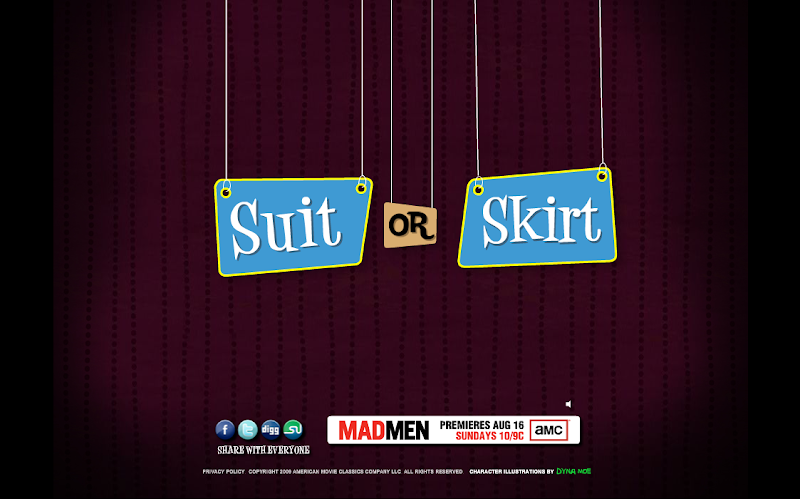
The latest is AMC's "Mad Men Yourself," and this one has an interesting backstory.
The series quickly developed a following in both real and virtual settings, e.g. Twitter, because it appeals to agency/media/marketing people who also happen to be early adopters of Twitter and other social networks. A lot of these creative-types did some really neat things with the characters on the show, and AMC did some really stupid things and then took it back and a year later, wised up and created the following awesomeness, a perfect reflection of the "brand" that is Mad Men, and the "fans" such as Dyna Moe, who created the illustration for the site:
Congrats, AMC. You finally "got it," and your show is saved.
PS - Does the music remind anyone else of the old The Sims when you were in "buy" mode? Ahh elevator music. Never goes out of fashion.
PPS - Eight O'Clock Coffee gets a Brand + in my book for a perfect sponsorship deal:
I'm doing my part by wearing red & white nail polish during finals. Hope it brings some good Karma my way ;-)
Also look for Temple's "Cherry & White" colors around Philly all week (May 11-17) surrounding the Commencement ceremony on May 14. See if you can spot the following landmarks and buildings with Temple's colors:
Ben Franklin Bridge
One Liberty Place
Two Liberty Place
Cira Centre (look for the Temple 'T')
Boathouse Row
Bell Atlantic Tower
City Hall and along Broad Street
Send your favorite cherry sightings to me or to Temple's site and tweet them on Temple's new Twitter account if you're into that stuff.
The "I'm a Temple Owl" video contest finalists were announced today as well. Here is a stream of the finalists, the last one being the winner (Dan McKinney). My personal favorite is the third, but I'm biased being a part of the Fox School of Business myself!
Finally, for the alumni, it's Alumni Weekend at the end of the week, May 15-17. The scheduled events required registration, which closed last week so hopefully this isn't the first you're hearing about it...
Do you give your e-mail out at networking events and conferences?
In the fall semester, one of my marketing professors here at Temple paid out of pocket for a bunch of us American Marketing Association (AMA) students to go to a great conference in New York City. The conference was organized by the Advertising Women of New York (AWNY) and took place at the Fashion Institute of Technology in Chelsea (downtown Manhattan). Here we are at the conference:
I got on AWNY's mailing list and last week received an e-mail about an internship opportunity for the summer 2009. Mind you, I haven't received one e-mail from them up until now, and I don't need an internship myself but I was excited to pass this along.
UPDATE: I was going to post the internship description here but Lynn Zalokar, AWNY's Membership Manager has asked me to take it down, since she has already received a number of resumes and only has one spot left.
Lesson learned: you never know when an opportunity may arise and you have to be quick to snatch it up. This can be really frustrating, especially when it seems like all the doors are slamming in your face. Stay positive and keep APPLYING YOURSELF through these tough times. I'm going to make my next entry more inspirational. In the meantime I'd like to know, what creative job-search strategies are you using?
I was sitting at home watching TV tonight (not a normal occurance) when I discovered another successful endorsement / partnership deal IMHO.
This one involves British pop singer Estelle and Kraft Foods' powedered drink product Crystal Light. Kraft is using Estelle's song, "Star" to promote their product in the TV commercial, and is offering a free download of the "Star" mp3 at uPumpItUp.com. I couldn't get this song-jingle out of my head, so if you're going to watch it with the volume on, don't say I didn't warn ya.
When you go to the website to download the mp3, you can also find other cool stuff, like this drink recipe:
Starlight
Makes 12 Servings (1/2 cup each)
1 single serve packet Crystal Light On The Go Immunity: Cherry Pomegranate
1/4 cup cold water
1 bottle (750 mL) champagne, chilled
Place drink mix and water in measuring cup; stir until dissolved
Add 1/2 tsp mixture to each champagne glass; top with champagne
TECHNOLOGY IN MARKETING
Representing and Misrepresenting Yourself on Social Networks: A Cautionary Tale for Marketers
by Amy Pospiech 12/16/2008
This assignment is an individual research paper on the topic of social and ethical issues of technology. The issue is authenticity in social networks as it relates to public policy and marketing. Includes a summary of different perspectives or responses; conclusions and implications for marketers and public policy makers.
Social networks are now a big part of mainstream culture in America and throughout other parts of the world. Facebook, myspace, Flickr, blogs, YouTube, and all aspects of Web 2.0 are now literally used by everyone and their mothers (Elevenmoms 2008), in some cases even babies (Menscher 2008) and plants (Bray 2008) – sort of. Because of their ease of use and widespread adoption, many creative uses of the internet and Web 2.0 have developed, not only by tech-savvy individuals but by consumers, kids, artists, and marketers with a little time and energy. However, amidst all this content, it can be easy to get lost, confused, or frustrated. A user may begin to wonder, “How reliable or credible is the source of this information?” “Who is actually responsible for the creation of this content and what purpose does it serve?” “Is this content purely for entertainment or does the author have some hidden agenda?” Sometimes, a misleading video, article, website, or social networking profile may be seen as malicious, misguided, or worthless, and the author is either condemned or ignored. Other times, a creative case of misrepresentation may be praised and lauded throughout the community even after it has been “discovered.” It seems that the issue is one of authenticity. Especially now, with more marketers and businesspeople entering the Web 2.0 circle for professional rather than personal purposes, consumers are delighted to point out when someone has failed to adequately disclose their purpose. Even with proper disclosure, some users are upset by ideas like “Pay-per-Post” which damages the “integrity” of a blogger’s personal and respected opinion. For example, Chris Brogan’s “Sponsored Post-Kmart Holiday Shopping Dad Style” was enough to set the tweet-o-sphere (via Twitterers) and the blogosphere (via Bloggers) on fire, even though it clearly stated that it was a sponsored post in the title and first few lines of text, and it appeared on his Dad-O-Matic blog. Some responses were along the lines of, “My beef is that I would rather hear from a real shopper. Can’t Kmart find *someone* who’s shopped there for years who wants to tell you and me why they like Kmart?”(Fialkoff 2008) and “I think he caught flack due to the brand he chose to associate with.” (Singer 2008). So the issue here was not just whether the post was sponsored, but whether it was solicited or “real,” even though it was seemingly a favorable matchup for both parties. Chris Brogan is a well-respected social media maven. He is “a ten year veteran of using social media and technology to build digital relationships for businesses, organizations, and individuals. Chris speaks, blogs, writes articles, and makes media of all kinds at [chrisbrogan.com], a blog in the top 20 of the Advertising Age Power150, and in the top 100 on Technorati” (Brogan 2008). It made sense for Kmart to choose such a high-profile blogger to raise awareness for their brand. But the approach may have seemed too market-y, as Chris Brogan was only leveraging his status as “dad” for the brand which, perhaps, he had not capitalized on before this sponsorship. To avoid this problem, analyst Jeremiah Owyang states that when doing sponsored posts, “Bloggers will simply have to ensure that they are delivering trusted content to their audience (transparent), and it’s relevant to their current topics (authentic). If readers are going to a tech blog, and expecting tech content, they may be surprised if the content shifts to a different medium – like consumer goods… The good thing about the blogosphere is that it self corrects, the community members will let the blogger know what they do and don’t like – it happens every day” (2008). Certainly, this is a case where the blogosphere shows its self-correcting nature. In response to the negative feedback on Twitter and in the blogosphere, Chris wrote his own post, justifying his choice for doing the sponsored post. It included his relationship with the sponsoring company, Izea (formerly associated with the controversial Pay-per-Post), and his wanting to “experiment” with the paid post system. His response to the buzz about the “purity” of the blogging platform and the internet was, “My job isn’t to keep the Kumbaya chants going. It’s to equip businesses (and that’s on the blogger side *and* the big business side) with knowledge and actionable next steps” (Brogan 2008). This entry, entitled “Advertising and Trust,” received 222 comments of its own in just over three days, with the original paid post receiving over 400, as entries into Kmart’s holiday contest. So the post exposed two things: First, a sponsored post must be a perfect alignment between blogger and sponsor, or else it will come off as fake and potentially weaken the reputation of both parties involved. Second, even a misaligned sponsorship can generate some buzz about a brand or contest, and may generate some excitement from those that aren’t upset over the whole sponsorship idea, such as these bloggers: “Kmart was very smart at reaching out to Chris Brogan. Far away from scholastic definitions of marketing and social media, Chris Brogan has a heart. His followers know it. What is the value of that? I think you -and Kmart- will find out” (Hart 2008) and, “After all he is a blogger who works in the business and marketing field, giving useful advice for free and never too busy to reply to a serious email or tweet. He’s not some kind of anarchist grimly struggling against authority and many of the usual suspects in Chris Brogan’s blogosphere salivate over the chance to get paid to blog” (Cox 2008). So, while some people feel slighted by the idea of paid posts and endorsements, or even jealous that they’re not getting paid for their own opinions yet, others don’t mind them and see them as a normal part of business (“you’ve got to live”)or a positive aspect of the blogosphere when executed correctly. Owyang also mentions that “recent research shows that corporate blogs are not trusted, but we know that consumers trust their peers, so savvy brands will want to benefit from word of mouth” (Owyang 2008). Yet this case study shows that there is more to it than soliciting “peers” to advocate a brand, as these “peers” must not only spark a reader’s interest, but their trust. They must be seen as speaking from the heart, and advocating a brand because of its application to their particular area of expertise, adding value for the readers of the blog. Finally, a sponsorship must feel organic, not contrived. Another case where marketers have tried to use well-known figures to promote their brand, to a mild degree of success, is with AT&T’s new campaign, “Lost in America.” This campaign consists of a video series featuring two young starlets being taken on random adventures throughout the country. Unlike the Chris Brogan sponsorship, these characters were chosen based on their relevance to the target market of the company. According to girls’ bios on the site: Karen: Karen has a very healthy and normal obsession with social media, fruit and "The Wizard of Oz". She is heavily involved in online social communities like Facebook and Twitter and enjoys trying out new web technologies. She continues to shoot and edit short videos whenever inspiration strikes and regularly blogs on her site karenism.com about technology, film and food. iJustine: With a catalog of more than 300 videos and 3,000 photos published online, Ezarik "is the Internet". A connoisseur of all things Internet, a gadget girl and a comedienne; iJustine represents a new kind of media star. Interesting to note, iJustine was first made famous by her extremely lengthy iPhone bill, making her the perfect selection for AT&T’s campaign. There are currently 16 “episodes” posted at attlostinamerica.com; the first one is titled “Alaska Ep. 1 'The Drop-Off’” and described: “In the premiere episode of Lost In America, our participants Justine & Karen are dumped out of a van in different parts of Anchorage, Alaska.” Similar episodes follow, with the girls using only their AT&T phones to navigate their way around the country. While the sponsorship is clearly evident, the campaign received some heat from an AdAge reporter, “The series is heavy on AT&T, but light on storyline, unless you find it interesting that Justine could be booted out of the competition if she drops her phone a fifth time” (Learmonth). So, here is an example of a perfectly-matched partnership between two social media mavens and a tech company, but because it is so overtly promotional in nature and lacking real “content,” it has received little buzz and the viewer stats aren’t as impressive as, say, iJustine’s own YouTube channel. Moving from weak sponsorships and partnerships, there are some inspiring examples of unsolicited brand advocacy which have generated some attention in the Web 2.0 world. One to note is the Darth Vader character from Star Wars who tweets regularly. Clearly, it is not Darth Vader himself behind the mask. Or is it? He stays remarkably on-character and his tweets are entertaining enough, or strange enough, to command a large following. An example of a tweet which does not advocate a particular brand but jives with the current economy: “Tarkin says we have to make cut backs. Stupid union clone troopers make $70 an hour and naturally, there's like a million of them. 3:59 PM Dec 12” and one which apparently does advocate a brand: “Totally had Tarkin convinced they named Black Friday after me. He was waffling until I whipped out my Vader Master Card - http://bit.ly/UAeh 9:20 PM Nov 28.” The link takes the user to a Darth Vader Master Card promotion. (Note: Tarkin is another Star Wars character). While it doesn’t seem that Darth Vader receives any type of a compensation for his work, he has over 20,000 followers and could drive significant traffic to another site. The point is: here is someone who remains anonymous and takes on the persona of a famous character. His “followers” know it’s not really Darth Vader behind the tweets as much as they know it’s not really Santa who delivers presents on Christmas morning, but it’s the kind of thing people don’t mind seeing because it is entertaining and even a bit inspiring. And it doesn’t even matter who the guy or girl behind the tweets really is, or if they’re paid off or not. Of course, if some individual was contracted to make a Twitter account and try to generate “buzz,” the stream might not be as popular, seeming phony and scripted. Yet, if that individual were James Earl Jones, well then you might have a quality social media implementation. The point is not to try to “fool” users, but to use spoofs that are highly-entertaining or obvious. In previous years of Web 2.0, some marketers and public relations staff misused technology, such as forums and review sites to post positive feedback on their own products, generating bad PR and backlash from the community. This was a violation of user’s trust and pitted them against the evil “marketers” who violated their social spaces. In current years of Web 2.0, public relations staff has become overly protective of their brand and brand image, and now the marketers don’t trust the users, either. There is a concern over copyright infringement and of course, fear that someone else may destroy a brand’s image through parodies and spoofs via sites such as YouTube and blogging platforms. It comes as no surprise, then, that when unsponsored “Mad Men” characters from AMC’s fading TV series set in the 1960’s started signing up for online profiles and gaining a large following, the parent company AMC reacted. The “characters” Don Draper, Roger Sterling, Joan Holloway, and Pete Campbell were supposed employees of Sterling Cooper Advertising from 1962 and, consistent with the television drama, their Tumblr.com and later Twitter.com presence maintained their characters’ voices. They offered advice to other users and even a subtext to the television series. However, when AMC discovered what was happening, they took a fearful approach. Twitter was contacted and the offending accounts suspended. This attempt at controlling the “fan fiction” may have caused even more damage than good; the company’s negative response was the call to action for a website, WeAreSterlingCooper.com, with the manifesto, “Fan fiction. Brand hijacking. Copyright misuse. Sheer devotion. Call it what you will, but we call it the blurred line between content creators and content consumers, and it's not going away. We're your biggest fans, your die-hard proponents, and when your show gets cancelled we'll be among the first to pass around the petition. Talk to us. Befriend us. Engage us. But please, don't treat us like criminals” (Caddell 2008). Many blog articles and Twitter streams were created as a result of this. “As lawyers often do, their threats had created far more controversy and negative publicity than the fans could have possibly threatened” (2008). The website offers links to many of them, as well as a downloadable 11-page .pdf documenting the series of events, called “Becoming A Mad Man,” written by one of the Mad Men named Bud Melman, real name Bud Caddell . His account was not one of the 9 shut down by AMC because his presence was invented solely online and not in the series itself. Caddell acted as a facilitator in the post-suspension phase, gathering all the Twitter users and concerned members of the community together to create unity and determine their purpose. He writes: When I asked why each person had chosen to start twittering as a fictional character from a television show, the answers were varied but shared a consistent theme: love. Our strange new behaviors and identities were the result of an advanced relationship to the world of AMCʼs Mad Men. It was our appreciation of the subject matter, the writing, the acting, and the product as a whole that spurred our expression. We were contributing freely, and no conversation about compensation was had. We were operating under the typical fan community “gifteconomy.” But regardless of why we got started, we all saw this as an opportunity to prove a model, that fans and brands should work together and create together (and we all still hoped AMC would respond to us). We were all very much invested in the success of our characters as a new form of engagement and as a way to create more meaning and relevance with fans. So, with all of this Web 2.0 jumble of good-and-evil content, how do marketers ensure the consistency of their brand image and message, while promoting active user communities? It seems that the trick is a mixture of “listening in” along with “guerrilla” tactics that make use of current user communities. If consumers are creating positive fan fiction and it does not harm your own company’s reputation, message, etc., then let it live. Promote it. Encourage the authors. Feature them in a press release. Do an interview with them. Link to their sites / content. E-mail them. Friend them. Whatever the case, if they already love your brand enough to spend significant time developing content about it, it’s almost guaranteed that they’d appreciate the recognition. If the number of self-help blogs and articles written recently is any indication, and the number of replies many of them receive (Chris Brogan’s included), this is certainly the case. So a starving creative would most likely be thrilled by a contact from a real company that they have a pre-existing passion for. Marketers, pay attention! On the other hand, if negative content is created, a marketer should do more of the listening before reacting like AMC’s representatives. Figure out what’s wrong. Solicit opinions. Ask how the product / service can be improved. By asking to shut down a popular user profile or by threatening to remove objectionable content, a company representative will fuel the hatred that was brewing when the content was being created. Do not upset the influential users of the Web 2.0 world, as they will surely make it known to others and find a way around the obstacles being superficially created for them. They can always set up a copycat website, create a new profile, etc. This is the gift and the curse of the ever-changing, constantly updated, collaborative Web 2.0 revolution. In soliciting feedback rather than attempting to remove some misrepresented facts or opinions, a marketer / PR representative can act in a proactive, rather than a reactive or protectionist manner. This will cast the company or brand in a much better light. The author may even change their opinion, or reveal that they don’t even mind the brand all that much anyway, as was the famous case where Starbucks attempted to sue comic-book illustrator Kieron Dwyer for making a spoof of their logo. Dwyer’s green-and-white siren carries a cell phone and coffee cup, and is tagged with the text “consumer whore.” However, he didn’t really mind the brand all that much – just the waste that came to his neighborhood once Starbucks moved in. It was only after the lawsuit that he stopped drinking their frap’s every morning. He writes, “as much as I was mocking Starbucks and their rampant consumerism, there was also self-awareness and some irony to it because I was mocking myself and everybody else who was making their way like lemmings off a cliff to Starbuck’s every day” (Dwyer ). Sure, the logo was offensive, but a polite notice or initiation of a conversation with Dwyer would have sufficed to have its circulation halted. At that point, if Dwyer was unresponsive, a lawsuit may have been necessary, but not before. From a public relations perspective, the approach of Starbucks was uncalled for. After all, isn’t Web 2.0 all about engaging your customers with conversation? Armando Alves, author of the blog A Source of Inspiration, writes about the “brandjacking” phenomenon and how companies can prevent or control it. “Brand Hijacking happens when consumers appropriate the brand for themselves and add meaning to it… brands should act as facilitators, opening communication channels and providing tools and materials (if you’re really hip, wrap it around a Creative Commons license) to consumers” (2008). He highlights the Mad Men story described earlier and goes on to list some best practices for companies to prevent a user from completely abusing the system, including: 1. Register your brand/product name early. 2. Define procedures for brand hijacking as one of your social media best practices. A simple social media policy will do. 3. Get your voice. Is it a push model, or do you actually engage with the users? Delegated or internal? Formal or Informal? 4. Provide aggregation mechanisms. 5. Track your brand buzz. 6. Have a consistent alias/nickname in different services. These suggestions will help prevent such practices as cybersquatting, where a user registers a domain name similar to your own brand, with negative intentions – either for money or recognition. Even so, brandjacking may occur in obscure ways, so companies must always monitor social sites to discover relevant discussions and user profiles, whether intended for creative entertainment or not. One realistic example of brandjacking which occurred this summer was an “employee” of Exxon Mobil’s via a Twitter page. Janet’s completely unverified posts went along the lines of: "we are not an earth hating organization, and we’re working on hard to improve how we drill for oil, these are difficult times. we used revenues as reinvestment into R&D. In 2007 we invested $21bil in refining capacity to reduce the future cost of petroleum. Did You Know? ExxonMobil reduced its Greenhouse Gas Emissions by 5 million metric tons from 2006 to 2007! ExxonMobil’s primary concern is to safely provide reliable and affordable supplies of energy to people around the world" Within three days “Janet” was discovered to be a fake. Here is the response of Alan Jeffers, a real an Exxon employee: “There are only people that are authorized and not-authorized, even people with the best intentions, may not know what the appropriate position is or the facts, we think that there’s a problem, as we don’t want to be misleading people and there’s a lot of errors what the person is posting even if it was something that had the best of intentions could be misleading. It’s our perception that social networking is based on honesty, transparency and trust, it’s important that they become forthcoming about who they represent” (Owyang 2008). While this brandjacking only lasted for three days before it was discovered, if it had gone on for longer it could have caused some real damage to the company, since she had most of the Twitter community’s belief and support behind her. When she was discovered, she even refused to take down her account and give in, claiming she was in fact “an employee of ExxonMobil, who has decided to put forward her pride in her own company” (Diaz). But since verifiable Exxon executives denounced any relations to her, the feed has since been removed. This case highlights a slightly scarier view of social media: that users blindly trust certain content, such as this Twitter page, because it offers them opinions that they want to hear. Perhaps this “Janet” was just a means to reassure a failing economic landscape that someone is there to help, or perhaps “Janet” is a huge nutcase who actually just thinks of her lying self as an Exxon brand advocate. But comparing that to the Chris Brogan case and the other “brand advocacy” cases where sponsorship was involved, and the situation becomes even more interesting. A fully-disclosed sponsorship agreement from two credible sources received a lot of negative heat, even though both brands were well-liked and respected in general. An undisclosed, unverified brand advocate for a generally un-liked brand (i.e. Exxon Valdez) receives more “hmm, stinks for Exxon” reactions than “how dare she/they!” And if she were an actual employee, doesn’t that necessitate her payment for this undertaking? So it can’t be about the paid / unpaid thing. This whole “social media networking” seems to be a bit finicky. People weren’t sure whether the Mad Men were sanctioned by AMC, but they didn’t care as the accounts were not representative of real people, but characters playing a role in a fictional drama set in the 1960’s. They were entertaining. Darth Vader uses a similar setup where he plays a role, regardless of whether he’s backed by the Star Wars creators or not. Fellow Twitterers don’t expect him to be a real person and follow him simply for amusement. No one really criticized “Janet” for her blatant misrepresentations, but instead wishes that Exxon would get involved in conversations with consumers in the future. No one can even criticize iJustine partnering with AT&T, because she was essentially made famous with the iPhone, so her approach is totally on-brand and in character, albeit a bit tired and dull. But Chris Brogan, Pay-per-Post, used car salesmen, and salesmen in general appear “unauthentic,” receiving plenty of criticism and negative attitudes. Sure, they get some sales sometimes. Overall, the best idea for a marketer: don’t stick your brand where it doesn’t belong, and where it already exists, find the most enthusiastic supporters and listen before acting. Figure out what’s working. Find the right community, find people who already love your brand, and foster that community to promote the brand equity that is already growing there. Don’t get too “market-y” or “sell-y” with users, or it will deteriorate the authenticity of that blog, forum, partnership, brand, etc. That doesn’t mean every “fan fiction” or derivative work must be removed: on the contrary, if something is authentically enthusiastic, onbrand, or otherwise engaging in a positive way, it should be cultivated and nurtured like a little plant who tweets. Something as “false” as a talking plant can still be “authentic” if done correctly.
Works Cited
Alves, Armando. “Social Media and Brand Hijacking.” September 3, 2008. Accessed December 12, 2008. AT&T. “Lost in America.” Bray, Rebecca, Rob Faludi, Kate Hartman, and Kati London. “Botanicalls >> Kits.” Botanicalls.com. Accessed December 14, 2008. Brogan, Chris. “About.” chrisbrogan.com. Accessed December 12, 2008. Brogan, Chris. “Advertising and Trust.” chrisbrogan.com blog. December 13, 2008. Accessed December 16, 2008. Brogan, Chris. “Sponsored Post-Kmart Holiday Shopping Dad Style.” Dad-O-Matic blog. December 2, 2008. Accessed December 14, 2008. Cox, Darren Daz. “Should Chris Brogan get paid?” The Fine Art and Design blog of Darren Daz Cox. December 14, 2008. Diaz, Sam. “Internet brand-jacking: What can be learned from Exxon Mobil?” August 7, 2008. Accessed December 12, 2008. Dwyer, Kieron. “Kieron Dwyer.” Artist bio at stretcher.org. Accessed December 14, 2008. “Elevenmoms.” Walmart.com. Accessed December 16, 2008. Fialkoff, Josh. “Why Kmart is Wrong to use Chris Brogan.” Josh Fialkoff: Online Marketing, Wordpress & GTD blog. December 13th, 2008. Accessed December 16, 2008. Hart, Ana. “Why Kmart is Wrong to use Chris Brogan.” Comment on Josh Fialkoff: Online Marketing, Wordpress & GTD blog. December 13, 2008. Accessed December 16, 2008. Learmonth, Michael. “AT&T's iJustine Web Series Doesn't Exactly Go Viral.” AdAge. November 24, 2008. Accessed December 7, 2008. Menscher, Corey. “Kickbee.” December 13, 2008. Accessed December 15, 2008. and Messina, Chris. “Twitter hashtags for emergency coordination and disaster relief.” October 22, 2007. Accessed December 16, 2008. Owyang, Jeremiah. “Understanding Izea’s Sponsored Blogging Service.” Web Strategy by Jeremiah blog. December 14th, 2008. Accessed December 15, 2008. “How “Janet” Fooled the Twittersphere (and me) She’s the Voice of Exxon Mobil.” Web Strategy by Jeremiah blog. August 1, 2008. Accessed December 15, 2008. Singer, Adam. “Chris Brogan's Sponsored/Paid Blog Post for Kmart.” Comment on The New Advertising blog. December 14, 2008. Vader, Darth. Profile on Twitter. Works Referenced Anand, Geeta; Basu, Abhijit; Beckett, Paul; Sircar, Subhadip. “Dozens of People Killed in Mumbai Attacks.”November 27, 2008. Alexander, Bryan; Levine, Alan; “Web 2.0 Storytelling: Emerging of a New Genre.” Educause Review; Nov/Dec2008, Vol. 43 Issue 6, p40-56, 11p. EBSCOhost. C, Omar. “Map of Mumbai attacks.” November 26, 2008. Accessed December 15, 2008. “Cartoonist Kieron Dwyer Sued By Starbucks.” Comic Book Legal Defense Fund. New York, NY November 30, 2000. Godin, Seth. “How to tell a great story.” April 2006. Appendix A: Images 11 moms Walmart campaign Kieron Dwyer’s Starbucks spoof Darth Vader’s idea of a joke Mad Men Season 2 – likely to Tweet? “Brandjacked” Exxon Mobil
And finally, Izea, the evil "pay-per-post" founders (just kidding...er): "Sponsored Tweets : 10k Users" on July 30; To encourage people to signup I am going to give $1k to the 10,000th person to signup.
Look what I found at the Library of Congress site (my treasure find, it's like I won the lottery or something - see post about the old-school LOLcats):
Smoke Now! ...Be Happy Hereafter Gonzalez & Sanchez Havana Cigars ...for Women Only
A Story of a Spoiled Evening By ROBERT TANNER
I'M A MAN - at least I wear trousers and No. 8 shoes and smoke and drink dopes and uster drink beer and have all the outward and visible signs of manhood and most of the inward and ingrowing vices, so I feel like I'm a regular Webster when it comes to being an authority on men's dispositions.
I know you want your husband to join you in a better world when he finally kicks out down here and while I cannot begin to tell you ALL the things that will help along that line - me not being a preacher as far as you can notice it - I can say one or two little things that are right pertinent.
Isn't this just so... old school? They could never get away with this stuff nowadays: "for Women Only" it says. I think the feminists AND the men would have a protest about this one. See the entire text here.
Stay tuned for a printable mini!
Advertising Ephemera Collection - Database #A0160
Emergence of Advertising On-Line Project
John W. Hartman Center for Sales, Advertising & Marketing History
Duke University Rare Book, Manuscript, and Special Collections Library
http://library.duke.edu/digitalcollections/eaa/
In my technology in marketing class this semester, we've been discussing social media and how companies can use this new platform to build their brands and relationships with consumers. My group did a breast cancer awareness plan for the Susan G. Komen for the Cure football game/fundraiser back in October, and a social media plan for the Kodak brand last week.
Our big idea for Kodak was to revitalize the brand by building on the "spontaneous" factor of a Kodak Moment. Our viral marketing would center around a "Make this Your Moment" contest encouraging uploads to the online photo-sharing service. Video clips of faceless characters in humorous situations would be propagated around the web to drive traffic to the contest site.
Here's the PowerPoint we presented to the class (some weird buggy things happened while uploading online, though):
Social Media Plan for Kodak by Jared Fink, Justin Goh, Sean McCulley, & Amy Pospiech Our Goal Today • Discuss the Kodak brand and discuss how it is currently perceived in the minds of consumers • Re-introduce the “Kodak Moment” • Discuss challenges and opportunities in leveraging this brand equity • Reveal the proposed Kodak Moments Social Media Campaign Background: The idea of a “Kodak moment” dates back to 1888, when George Eastman put the first simple camera into the hands of consumers. Our social media plan will revitalize this idea of an unexpected moment captured by an amateur photographer on film, using a buzz marketing campaign urging users to “Make this Your Kodak Moment.” What is Kodak now? • Kodak is known for its ease-of-use. With its Kodak EasyShare camera and PerfectTouch photo processing, it is aimed at the novice or busy individual. Even the essence of a “Kodak moment” is captured by this quick, even spontaneous theme. Brand Model: Old A Kodak Moment is… • An event for which you or someone wished someone nearby had a camera to take a picture. “When we went to the zoo Amanda fell into the gorilla cage. It was such a Kodak moment!” by kalley treay Jul 3, 2007 • A rare, one time, moment that is captured by a picture, or should have been captured by a picture. “Aww!.. They look soo happy sitting there by the lake! That's definetly a kodak moment!” by LiL' LAdY Nov 3, 2006 • Said when something funny happens Creative Consulting Current Web Presence: Snapshot • “Leading online digital photo developing service” • Secure and easy way to view, store and share photos with friends and family • Free editing and creative tools and specialty photo products • Similar to all other online tools Current Web Presence: A Thousand Words Blog • “What’s a picture worth?” • Off-brand, too general • Recent posts include topics as varied as pumpkin carving (incl. hardware tips), a flower photography class, and the end of a NASCAR sponsorship • Should be kept internal Current Web Presence: PluggedIn Blog • “A blog about Kodak products and customers” • Niche market (tech-y consumer) with a general description – needs better targeting • According to Technorati, the blog is ranked 150,646 and has an authority of 43 (in other words, 43 other sites have linked to it) Snapshot: Current Web Presence • Podcasts Twitter Facebook Youtube Flickr Delicious Professional Perceptual Map Cluttered Streamlined Amateur Moments Kodak Moments’ Target Audience • Those who remember the magic of the unexpected, spontaneous Kodak moment • Those old enough to appreciate the idea that life is fleeting, and have little time to preserve their moments through competitor’s cluttered, complicated websites • Those who appreciate a tactile experience like flipping through a photo album Brand Model: New Proposed Web 2.0 Presence Contest Details: “Make this Your Kodak • In order to create a buzz throughout our target market we are promoting a contest using short video clips • These clips will be distributed throughout the web on social networking sites • The winner of the contest will win a vacation tour of Italy were they can make of hilarious as well as special Kodak Moments Make this Your moment Online Ad Placement Mobile Marketing Make this Your moment Conclusion • Through the use of various social media channels, we will reinvent the Kodak brand image with Kodak Moments. • KodakMoments.com will touch the hearts and souls of the target market when they relive passionate still shots in a warming virtual atmosphere. • KodakMoments.com will simplify the online photo experience. Thank you
Ironically, Kodak had another agency come up with a similar idea about a month ago: Make Me Super. This site was created by an ad agency called EVB, owned by Omnicom Group. In reality, their idea is remarkably similar to the "Elf Yourself" OfficeMax campaign, and a lot like the earlier yearbookyourself site which inspired this series of Facebook photos (and our own project):
However, the Make Me Super project seems to lack that defining brand mark. That thing which makes Kodak, Kodak. Where have all the moments gone?
You can hear the entire presentation via a class capture of our group for as long as Temple keeps it up. Hope this isn't any type of privacy violation, haha. As far as I know, this is publicly available content. Anyway, enjoy.
So I don't know if it's because I'm now more aware of this social media craze, or if it actually is growing (at an insanely exponentially ridiculous rate), BUT:
Facebook has become standard lingo - I'm almost sick of hearing the word, especially in the context of, "let's create a facebook group to get people to love us!" Ho-hum.
I've found so many blogs with interesting content, and even more that rip that content and re-post on their own blogs (with a credit link, of course), and so many tools to "sort through the clutter" that even the tools themselves are starting to add clutter to my life (StumbleUpon, Delicious, TweetDeck, FriendFeed, Google Reader, meta tags) ahhh!
Ideas are being propagated, mashed-up, mish-moshed, re-syndicated, and re-created faster than you can find out where it even came from in the first place.
Messing around with Flickr a lot lately. I'm starting a group project in my Technology in Marketing class where we analyze how a brand of our choice can improve its use of social media (and all the Web 2.0 technologies). Our group chose Kodak. Remember those Kodak moments??
Anyway, I found so many cool things to do with my own photos while doing "research" online. A lot of them use Flickr's RSS stream. Check it out:
Moo.com,
QOOP.com,
imagekind. And, finally, my own portfolio, now integrating my Flickr stream right in the webpage (whenever I upload a new photo to Flickr it will upload there as well).
I'm looking into getting a domain name so it's easier to find my homepage. Maybe amyinkonline.com ... what do you think? The ones I've seen are only about $25 / year.
On another note, I'm entering the photo contest for International Programs at our school. I have to print out the 3 photos that I choose, but I haven't decided which ones to enter yet! The deadline is this Friday and I just ran out of ink on my printer. Eeek.
UPDATE August 17, 2009: I meant to post the pictured that I entered into the contest above. Two won honorable mention and were displayed in the glass case outside of the International Programs office for the rest of the year!
If you guess correctly which two won in comments I'll give you a prize :-)
Today, I found something remarkably similar, dating back to the 1900's. It's from an archive at Duke University. The illustration is part of a scrapbook collection of cut & pasted images - who knows where this one came from originally. But the comparison of humor in the 1900's to the humor of today is remarkable - seems we are still fascinated by the inner workings of our pets. Its caption reads, "HA! HA! HA! I'VE EATEN THE CANARY!" Click for a larger view:
Image 35 -- Hawley Scrapbook - Item #SB0058 Emergence of Advertising On-Line Project; F. W. Humphrey and Co. Duke University Rare Book, Manuscript, and Special Collections Library http://library.duke.edu/digitalcollections/eaa/
Although I've never had a cat, I have always wondered what my dog Luci might be thinking. Here's a few images I made for a calendar I gave to my sister last year:
From left: Luci (calm and lazy), Jersey (my cousin's energetic, fiery puppy)
Is it playtime now?
Some things never change. What would your pets say if we could hear them??
I started making two murals - which have stared me in the face as "works in progress" since high school. One is outlined on my sliding closet doors in black sharpie marker, waiting to be painted.
Click to enlarge.
The other began as a collage on some scrap foamcore in the art room long ago, and has been sitting propped up against my bedroom wall for a few years now. I decided to pick it up again the other day and it was very inspirational, both as art therapy and as a confidence booster. I don't always like the way my art projects turn out, but this one seems to have all the workings of a great piece. It still has a way to go, but I've made significant progress on it over the past few weeks...(Envisioned by Amy at 03:03 Tuesday 12 August, 2008).
UPDATE
I finished! Just before moving back here. I had to get it done and nearly pulled an all-nighter on Saturday 30 August, but it's now complete and hanging in my apartment downstairs:
This is me when I finished... after getting home from V Lounge in New Brunswick, near daylight, still dressed up, smeared makeup, but very happy!

 to my Posts
 by e-mail




.JPG)

.JPG)


